Recognition reform 2026: the new rules since 1 November

The cut-off date has passed. What now?
“I didn’t manage to apply before 31 October. Is that bad?” I hear this question almost every day at the moment. Mostly from colleagues whose documents were three-quarters ready and who now believe they have missed something.
The honest answer: usually not. A new law always sounds like new hurdles at first. But this reform is mainly a different order of steps, with less paperwork. Let’s calmly sort out what applies now, what stays the same, and how to submit your application without guessing.
What has changed since 1 November 2026?
Since 1 November 2026, for applications based on a degree from a third country, the Kenntnisprüfung has been the standard route to the Approbation, and the Gleichwertigkeitsprüfung has become an option that you must actively choose. This is set out in the new § 9d of the Bundesärzteordnung (BÄO, the Federal Medical Practitioners Act).
The key changes at a glance:
- Kenntnisprüfung as the standard route: as a rule, you prove your knowledge in an exam, no longer through a comparison of your study documents.
- A right to choose, with a deadline: the Gleichwertigkeitsprüfung remains possible, but only if you choose it within four weeks of your application. The choice applies to the whole procedure.
- Cut-off date: applications submitted by 31 October 2026 continue under the old rules.
- New rule on which state is responsible: if you live in Germany, the state where you normally live is responsible for your Approbation. If you live abroad, it is the state where you want to work (§ 12 Abs. 2a BÄO). The Berufserlaubnis (the temporary licence to practise) is still granted by the state where you will work.
- Fewer documents: if you do not choose the Gleichwertigkeitsprüfung, you no longer have to copy, translate and certify your curricula.
- Fixed deadlines for the authorities: confirmation of receipt within one month, a decision no later than three months after your documents are complete.
- A new Kenntnisprüfung format: a patient case with a written report and an oral-practical exam on the same day, with the same rules across Germany.
What has not changed: you still need the German skills required for the profession, usually proved through the Fachsprachprüfung. More on that below.
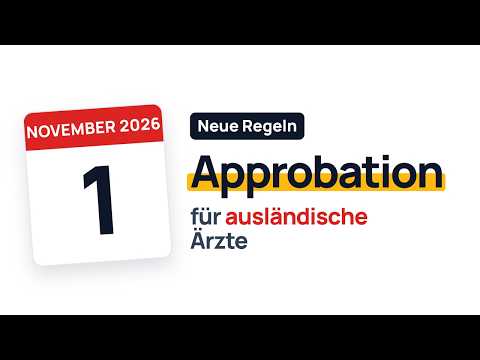
Our video (in German) also sums up the five most important changes in just over four minutes. It was recorded on 28 October 2026, shortly before the regulation was officially published. What counts is the information on this page and the answer from your authority.
Kenntnisprüfung as the standard route: what it means in practice
Until now, the authority first checked your documents to see whether your degree matched the German one. Only if it found substantial differences did the Kenntnisprüfung come in. Since 1 November 2026, this logic has been reversed: proving your knowledge in an exam is now the normal case.
- Kenntnisprüfung (medical knowledge exam)
An exam based on the content of the final state examination in medicine. Under § 37 of the Approbationsordnung, it consists of taking a history from and examining a patient, a written report and an oral-practical exam on the same day. Since 1 November 2026, it has been the standard route to the Approbation for degrees from third countries. It tests medical knowledge, not language.
The Federal Ministry of Health (Bundesgesundheitsministerium) explains the change by the effort the old assessment required: applicants had to have their training documents translated and submit them, and expert reports took time. The Kenntnisprüfung, by contrast, is one exam with the same standards for everyone.
How the new Kenntnisprüfung works
Since 1 November 2026, the procedure has been set out in the new § 37 of the Approbationsordnung für Ärzte (ÄApprO, the federal licensing regulations for doctors), in the regulation published in BGBl. 2026 I Nr. 326. This is the binding version, including the changes the Bundesrat (the chamber of the federal states) had requested in October:
| Item | New rule |
|---|---|
| Preparation with the patient | History-taking and examination of a patient or simulated patient, 20 minutes maximum, without seeing the file beforehand |
| Written report | Medical history, diagnosis, prognosis, treatment plan and epicrisis, 30 minutes maximum. Organisation, structure and clarity are also assessed |
| Oral-practical exam | On the same day, in German, 60 to 90 minutes per person, no more than four candidates at a time |
| Subjects | Internal medicine and surgery, plus emergency medicine, pharmacology, imaging, radiation protection, the legal framework and doctor-patient communication (ärztliche Gesprächsführung) |
| Exam dates | At least twice a year. You can take the exam within six months of your application; the invitation arrives no later than five calendar days beforehand |
| Resits | Possible twice |
Two things strike me straight away. The exam starts with the medical history, the report and the case presentation, which is exactly what also counts in the Fachsprachprüfung. And doctor-patient communication is explicitly part of the exam. If you have trained well for the FSP, you do not start this part from zero.
I explain in detail how the Kenntnisprüfung differs from the Fachsprachprüfung in the article FSP and Kenntnisprüfung: the differenceDE. In short: one tests your language, the other your medical knowledge. Neither replaces the other.
The right to choose: four weeks, one decision
Since 1 November 2026, you can only choose the Gleichwertigkeitsprüfung up to four weeks after submitting your application, and that decision is binding for the duration of the procedure. The authority must inform you about this option and its consequences (§ 9d Absatz 2 BÄO).
- Gleichwertigkeitsprüfung (document-based equivalence assessment)
A comparison of your foreign medical training with German training, based on your documents. After the reform, it only takes place for third-country degrees if you choose it within four weeks of your application.
There are two points in the law you should know before you choose:
- Substantial differences still lead to the Kenntnisprüfung. If you choose the Gleichwertigkeitsprüfung and the authority finds substantial differences, you will end up taking the Kenntnisprüfung after all.
- So do missing documents. If you cannot provide all the required evidence for reasons beyond your control, you must also take the Kenntnisprüfung.
So when is it worth choosing? Most likely when your study documents are complete and easy to obtain, and your degree is very close to the German one. Nobody can give you a guarantee, not even me. Ask your authority in the first few days after you apply, not in the fourth week.
Which rules apply to your application?
What matters is the date of your application: for applications with a third-country degree that were submitted by the end of 31 October 2026, the old rules continue to apply (§ 15 BÄO in its new version). The old version of the Approbationsordnung also continues to apply to these applications.
| Your situation | What applies |
|---|---|
| Applied by 31 October 2026 | Old rules: first the Gleichwertigkeitsprüfung based on your documents, then the Kenntnisprüfung if there are substantial differences. Your state’s rules apply as described in its guide |
| Applied on or after 1 November 2026 | New rules: Kenntnisprüfung as the standard route, Gleichwertigkeitsprüfung only if you choose it within four weeks |
| Degree from the EU, the EEA or Switzerland | No Kenntnisprüfung as the standard route: the authority first assesses your professional qualification under EU law |
| Procedure already under way | Your procedure continues under the rules that applied on the day you applied |
Some states had their own rules under the old law. In Sachsen (Saxony), there is no direct route to the Kenntnisprüfung for older applications; in Thüringen (Thuringia), these applications cannot waive the Gleichwertigkeitsprüfung. For applications from 1 November 2026, the new federal law applies there just as it does everywhere else.
Less paperwork: what changes for your documents
If you apply on or after 1 November 2026 and do not choose the Gleichwertigkeitsprüfung, you no longer need to submit any documents for that assessment, according to the Federal Ministry of Health. Curricula and lists of subjects then no longer have to be copied, translated or certified.
The regulation that goes with the reform also sets the form of the documents, in the same way across Germany. It was published on 30 October 2026 in the Bundesgesetzblatt, the Federal Law Gazette (BGBl. 2026 I Nr. 326), and has also applied since 1 November 2026:
| Item | Rule for applications from 1 November 2026 |
|---|---|
| Form | Plain copies or electronic submission. Originals or certified copies only if there are justified doubts |
| Translation | Only for documents issued in neither German nor English, and then into German or into English |
| Who translates | Publicly appointed or sworn translators (öffentlich bestellt oder beeidigt). The authority can allow exceptions |
| How recent | Evidence of good character (Zuverlässigkeit) and health must not be more than three months old when you submit it |
| Confirmation of receipt | Within one month, with a list of the missing documents |
| Decision | No later than three months after your documents are complete, four months with a Gleichwertigkeitsprüfung |
What you still need: proof of identity, a CV in table form, your diploma, your authorisation to practise in the country where you trained, a declaration that no procedure is under way in another state, and evidence of good character, health and language skills. Which form applies to which document, and what applies to older applications, is explained in the guide Documents for the Approbation.
What stays the same: the Fachsprachprüfung
Proof of medical German remains compulsory after the reform, because the German skills required for the profession are still a condition for the Approbation (§ 3 Absatz 1 Nummer 5 BÄO). Taking the Kenntnisprüfung route does not change that. In most cases, this proof is the Fachsprachprüfung at the Ärztekammer. Some states also accept other C1 certificates instead, such as the FaMed or the telc Medizin Fachsprachprüfung (C1), sometimes only under certain conditions. FSP Trainer is independent and is not affiliated with the FaMed provider or with the authorities.
- Fachsprachprüfung (FSP, medical language exam)
The medical language exam at the Ärztekammer (the state medical association), with a doctor-patient conversation (Arzt-Patienten-Gespräch), documentation and a doctor-to-doctor conversation (Arzt-Arzt-Gespräch). Proof of medical German at C1 level remains compulsory after the reform, whichever route you take to the Approbation. Depending on the state, other certificates such as the FaMed also count instead of the FSP.
One new element concerns the order. According to the Federal Ministry of Health, for degrees from third countries, the states may test your language even before they assess your professional qualification. For degrees from the EU, the EEA or Switzerland, the EU order stays in place: first the qualification, then the language.
In practice, this means the Fachsprachprüfung may come earlier in the procedure, not later. Who runs the exam, where, and for what fee is still up to your state. The differences are shown in the guides overview with all federal states, and which language exams count where, in the comparison of FSP, telc and FaMed.
The Berufserlaubnis after the reform
The Berufserlaubnis still exists: it can be granted on application to people who can prove they have completed medical training (§ 10 Absatz 1 BÄO). It is not granted for training qualifications from the EU, the EEA or equivalent states. The responsible authority is always that of the state where you will work (§ 12 Absatz 3 BÄO), even if you live in a different state.
For most colleagues from third countries, it therefore stays what it was: the bridge on which you are already working while your procedure continues. What you may and may not do with it is explained in the guide on the Berufserlaubnis for doctors. It can only be granted without a time limit in a few special cases that the law lists one by one.
What is still open
The legal framework is in place: the act and the regulation have been published and apply. What is still open is mainly the practice. How quickly the states update their information sheets (Merkblätter), forms and online procedures, and how quickly they offer enough Kenntnisprüfung dates, will only become clear over the coming months. In the first few weeks, expect information sheets that still describe the old rules. If in doubt, the law counts, not the form, and a short written question to your authority will clarify more than any forum.
We check the information in our state guides on an ongoing basis. The date of the last check is shown at the top of every page.
The waiting time is yours
Whichever side of the cut-off date your application falls on, there is time between your application and the Approbation. Proof of your language skills, usually the Fachsprachprüfung, is part of it in every case, and after the reform it can even come earlier than before. Use these weeks for what you can really train: speaking freely, documenting in a structured way, presenting a case clearly.
How to fit this in alongside work and your course is shown on the page Online FSP preparation alongside your course. How a complete exam works is explained in the overview Fachsprachprüfung: format and preparation.
Your one step for today
Haven’t applied yet? Then cross the curricula off your document list today and write this instead: “Four weeks after applying: make my choice.” If your application is already running under the old rules, nothing changes for you, and you can use the waiting time for the Fachsprachprüfung. A decision you prepare today is one you will not have to make under pressure later.
Speak. Practise. Pass.
Official sources
Only these offices are binding, not this guide. We checked the information with them in November 2026.
- Bundesgesetzblatt (Federal Law Gazette): “Gesetz zur Beschleunigung der Anerkennungsverfahren ausländischer Berufsqualifikationen in Heilberufen”, the act to speed up recognition in the health professions (BGBl. 2026 I Nr. 225, published on 28 July 2026)
- Bundesgesetzblatt: full text of the act, with the new §§ 9b to 9d and § 15 BÄO (PDF)
- Bundesgesetzblatt: “Verordnung zur Beschleunigung der Anerkennungsverfahren ausländischer Berufsqualifikationen in Heilberufen”, the regulation that goes with the reform (BGBl. 2026 I Nr. 326, published on 30 October 2026, in force since 1 November 2026)
- Bundesgesetzblatt: full text of the regulation, with the new §§ 37 to 39f ÄApprO (PDF)
- Bundesministerium für Gesundheit (Federal Ministry of Health): questions and answers on the act (as of 26 March 2026)
- Deutscher Bundestag: “Schnelle Anerkennung ausländischer Qualifikationen in Heilberufen beschlossen”, the Bundestag passes the act (March 2026)
- Bundesministerium der Justiz: Approbationsordnung für Ärzte, § 39 (version in force until 31 October 2026, still applies to older applications)
- Anerkennung in Deutschland: the federal government’s information portal, with free advice
Frequently asked questions
What has changed for the Approbation of international doctors since 1 November 2026?+
For applications based on a degree from a third country (outside the EU, the EEA and Switzerland), the Kenntnisprüfung (the medical knowledge exam) has been the standard route to the Approbation since 1 November 2026. The document-based equivalence assessment (Gleichwertigkeitsprüfung) now only takes place if you choose it within four weeks of your application. There are also simpler rules for documents and fixed deadlines for the authorities. The legal basis is the act in BGBl. 2026 I Nr. 225 and the regulation in BGBl. 2026 I Nr. 326.
Does the reform also apply to applications submitted before 1 November 2026?+
No. For applications with a degree from a third country that were submitted by the end of 31 October 2026, the old rules continue to apply (§ 15 BÄO in its new version). The old Approbationsordnung also continues to apply to these applications. What matters is the date of your application, not the date of the decision.
Can I still choose the Gleichwertigkeitsprüfung since 1 November 2026?+
Yes, but only up to four weeks after you submit your application, and the choice is binding for the whole procedure. The authority must inform you about this option and its consequences. If it finds substantial differences during the assessment, you still have to take the Kenntnisprüfung.
Do I still need the Fachsprachprüfung after the reform?+
Yes. The German skills required to practise the profession remain a condition for the Approbation (§ 3 Absatz 1 Nummer 5 BÄO). You therefore still need proof of medical German at C1 level, before and after the cut-off date. In most cases, this proof is the Fachsprachprüfung at the Ärztekammer (the state medical association). Whether your state also accepts other certificates, such as the FaMed or the telc Medizin Fachsprachprüfung (C1), is explained in its guide. For degrees from third countries, the states may even test your language before your professional qualification.
Do I still have to get my curricula translated and certified after the reform?+
If you do not choose the Gleichwertigkeitsprüfung, no: according to the Federal Ministry of Health, you then no longer submit any documents for that assessment, so you do not have to copy, translate or certify your curricula. You still need your diploma, your authorisation to practise, your CV and evidence of good character, health and language skills.
Are plain copies enough after the reform, instead of certified copies?+
Yes, for applications from 1 November 2026: you submit your documents as copies or send them electronically. The authority can ask for originals or certified copies if it has justified doubts about their authenticity or accuracy. This is set out in the regulation in BGBl. 2026 I Nr. 326, which has applied since 1 November 2026.
Are English documents accepted without translation?+
Under the new regulation, only documents issued in neither German nor English need a translation, and the translation may be into German or into English. In justified exceptional cases, the authority can ask for a German translation. As a rule, the translation must be done by a publicly appointed or sworn translator.
How quickly must the authority decide after the reform?+
The regulation requires the authority to confirm receipt of your application within one month and to tell you which documents are missing. It decides on the Approbation no later than three months after you have submitted complete documents; with a Gleichwertigkeitsprüfung, this deadline is extended by one month. The deadlines only start once everything is complete.
Does the reform also apply to doctors with an EU degree?+
The Kenntnisprüfung as the standard route concerns degrees from third countries. For degrees from the EU, the EEA or Switzerland, the authority continues to assess your professional qualification first under EU law, and only after that, among other things, your language skills (§ 9b BÄO). Your Approbation authority will tell you whether your degree is recognised automatically.
Does the Berufserlaubnis still exist after the reform?+
Yes. It can still be granted on application to people who can prove they have completed medical training (§ 10 BÄO). If your training qualification is from the EU, the EEA or an equivalent state, you will not receive a Berufserlaubnis. The conditions set by your state are explained in its guide.
How does the new Kenntnisprüfung work?+
Since 1 November 2026, § 37 of the Approbationsordnung has set out the procedure. First, you take the medical history and examine a patient or simulated patient (20 minutes maximum) and write a report (30 minutes maximum). On the same day, the oral-practical exam follows, in German, lasting 60 to 90 minutes, with internal medicine and surgery as the main subjects.
Where can I get free advice on the reform?+
The federal government’s portal Anerkennung in Deutschland offers information and free advice. A state authority is responsible for your actual application: if you live in Germany, the authority of the state where you normally live; if you live abroad, the authority of the state where you want to work. In the first few weeks, some information sheets still describe the old rules.
Glossary
- Anerkennungsreform 2026 (recognition reform)
- Short name for the act to speed up the recognition of foreign professional qualifications in the health professions (BGBl. 2026 I Nr. 225) and the regulation that goes with it (BGBl. 2026 I Nr. 326). Both have applied since 1 November 2026.
- Kenntnisprüfung (medical knowledge exam)
- An exam based on the content of the final state examination in medicine. Under § 37 of the Approbationsordnung, it consists of taking a history from and examining a patient, a written report and an oral-practical exam on the same day. Since 1 November 2026, it has been the standard route to the Approbation for degrees from third countries. It tests medical knowledge, not language.
- Gleichwertigkeitsprüfung (document-based equivalence assessment)
- A comparison of your foreign medical training with German training, based on your documents. After the reform, it only takes place for third-country degrees if you choose it within four weeks of your application.
- Drittstaat (third country)
- A country that is neither a member of the European Union nor a party to the European Economic Area (§ 2b BÄO). Degrees from Switzerland and other equivalent states follow the rules for EU degrees.
- Fachsprachprüfung (FSP, medical language exam)
- The medical language exam at the Ärztekammer, with a doctor-patient conversation, documentation and a doctor-to-doctor conversation. Proof of medical German at C1 level remains compulsory after the reform, whichever route you take to the Approbation. Depending on the state, other certificates such as the FaMed also count instead of the FSP.
Note: this guide gives a general overview and is not legal advice. Fees, deadlines and responsible offices can change. Information checked: November 2026.